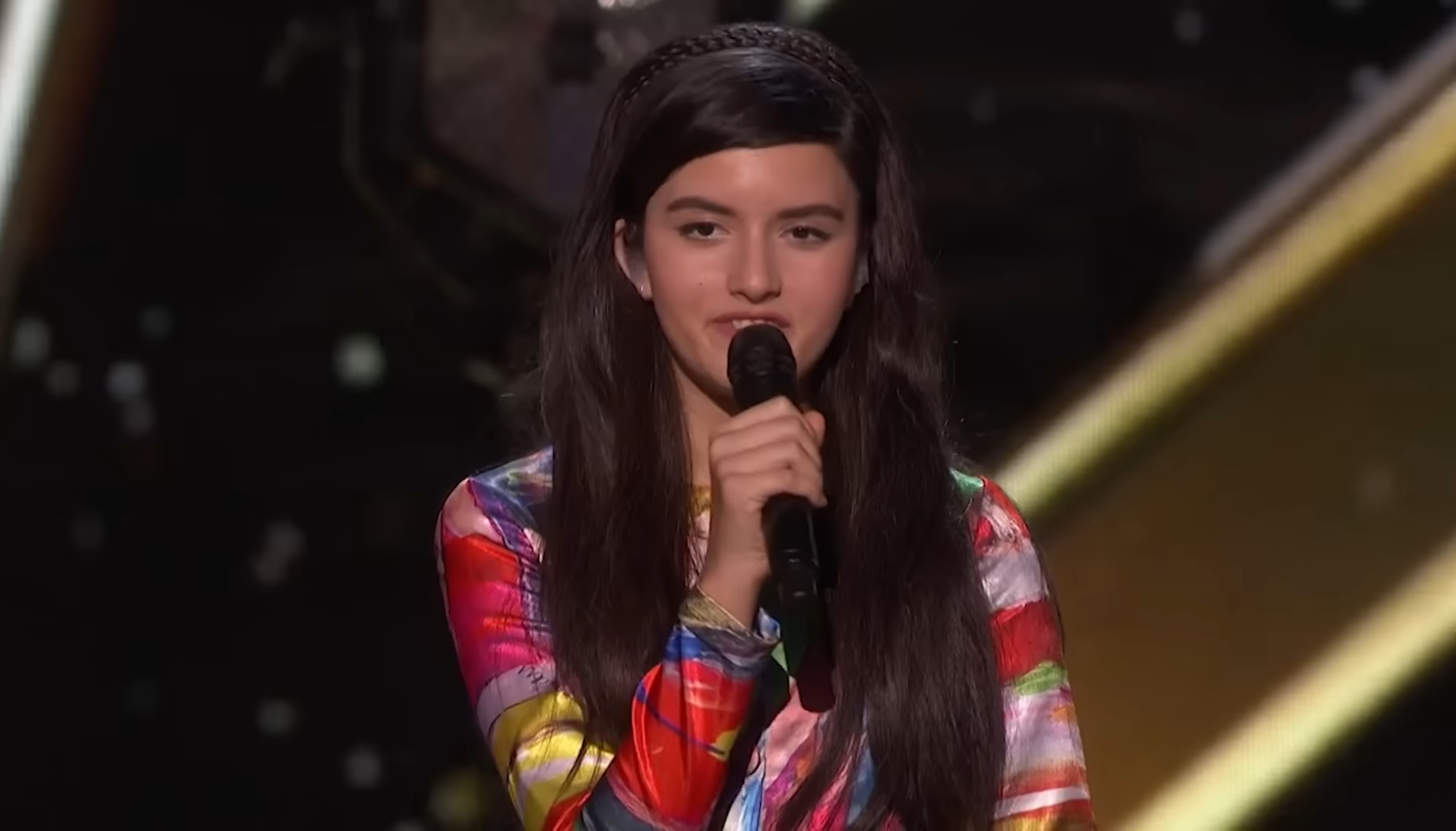
Angelina Jordan, a 13-year-old singer from Norway, walked onto the stage of America’s Got Talent: The Champions carrying more experience than her age might suggest. She had first captured national attention at seven when she won Norway’s Got Talent, and that early success had given her a familiarity with bright lights and big expectations. Still, this appearance felt different — a decade had passed, and with it had come a deeper musical identity. Angelina described herself as a lifelong lover of jazz, and she admitted the small, earnest wish she’d carried since childhood: to sing for Simon Cowell. After waiting ten years for the chance, she finally stood before the famed judge, equal parts nervous and composed, ready to make the moment count.
From the first second, the stage felt charged with possibility. Angelina opted to tackle a song that could have been the most obvious show-stopper: Queen’s “Bohemian Rhapsody.” But rather than mimic the bombast of the original rock opera — the layered harmonies, the roaring guitars, the theatrical crescendos — she chose a bolder path. Stripping the piece down, she reimagined it through the lens of jazz and torch-song intimacy. The choice itself was audacious: to take a universally recognizable anthem and render it almost unrecognizable, yet still utterly true. That decision revealed something central about her as an artist — a willingness to take risks, to trust her instincts, and to use interpretation as a form of storytelling.
The visual of her performance was simple and arresting. Angelina stood barefoot, in a plain dress, the lack of flashy costume keeping the focus squarely on her voice and presence. When she opened her mouth, the contrast between appearance and sound was immediate. Her voice possessed a depth and maturity beyond her years — smoky, resonant, and emotionally precise. She navigated Freddie Mercury’s complicated lyrical shifts not by imitating the original’s grandiosity, but by finding the human thread beneath them. Where the rock version explodes, Angelina softened and made the lines intimate, as if whispering confidences into a darkened club rather than commanding a stadium. Her timing, the small breaths she took, and the subtle phrasing all suggested a deep understanding of jazz phrasing and nuance.
There were moments in the performance that stopped the room cold. A suspended phrase held a heartbeat longer than expected, drawing everyone in. A delicate swing in a line invited the audience to lean forward. Her command of dynamics — moving from quiet vulnerability to swelling intensity — communicated the song’s drama without resorting to volume for effect. The camera occasionally cut to faces in the crowd: people visibly moved, some with mouths slightly open, others blinking back tears. It was the kind of effect that comes from letting a song breathe and trusting the listener to follow.
The judges’ reactions unfolded with the careful astonishment of people watching something rare. Alesha Dixon’s immediate “insane” capture of the moment reflected the high-energy shock many felt; she later expanded on that sentiment, saying she felt like she’d witnessed the birth of something extraordinary. Howie Mandel’s praise focused on the arrangement: he marveled at how original and refreshing it was, noting that he had never before heard “Bohemian Rhapsody” done in such a soulful, stripped-back way. The response wasn’t just about the vocals but the artistic vision behind them — the courage to reinterpret a classic and the skill to make that reinterpretation feel inevitable.
Heidi Klum’s reaction carried a different weight, a mixture of professional discernment and genuine emotion. After watching Angelina’s performance, she reached for the Golden Buzzer, a dramatic gesture that has become shorthand for a life-changing endorsement on the show. Her slam of the buzzer wasn’t impulsive; it felt like the crystallization of the entire room’s response. In that moment, Heidi acknowledged not only the technical excellence of the performance but its potential to transform a young artist’s trajectory. The Golden Buzzer sent Angelina straight to the finals, a unanimous and emotional affirmation from the judges that this was more than a memorable audition — it was the unveiling of a prodigious talent.
Beyond the immediate thrill, Angelina’s rendition resonated because it was deeply human. She managed to take the grandiosity of a rock anthem and filter it through the vulnerability of youth and the soulfulness of jazz. The performance felt like a conversation across generations: a child of thirteen interpreting a classic written in the seventies, bridging eras through her musical sensibility. For viewers at home, the image of a barefoot girl with a voice that seemed older than history itself was both disarming and inspiring.
As she left the stage — embraced by applause and the warmth of genuine recognition — it was clear that Angelina Jordan had given more than a performance; she had made a statement. Her audition was an assertion that artistry is about fearless choices and honest expression, and that sometimes, the most powerful moments happen when someone decides to reimagine the familiar in a way that makes you hear it anew.