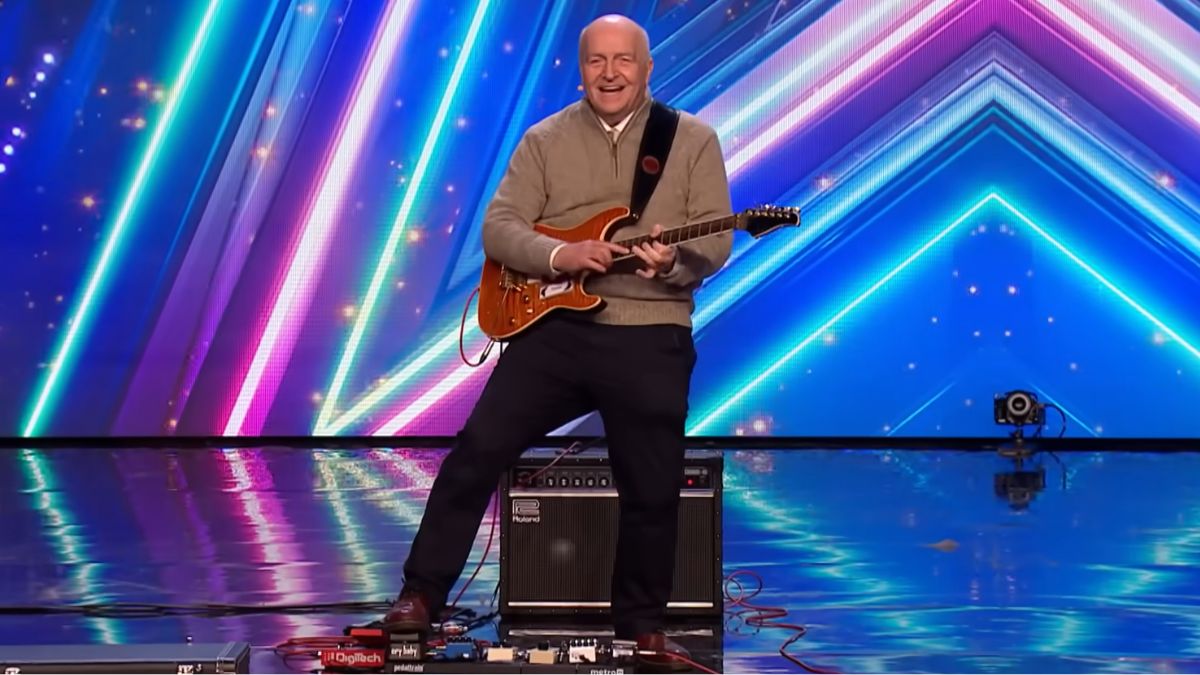
Sixty-four-year-old Kenny Petrie from Fife walked onto the Britain’s Got Talent stage looking every bit the mild-mannered, unassuming gentleman his quiet Scottish accent suggested. He had the soft smile of someone who enjoys a laugh and a chat, a tidy jumper, and an easy, polite manner that put the judges and audience at ease. When he spoke about wanting a “good part in the show” and joked that even Her Majesty the Queen might enjoy his act, it felt charmingly old-school — the kind of modest, self-deprecating humor that makes you root for someone before they even begin. There was nothing about his introduction to hint at what was coming; instead, it felt like the calm before a storm.
That storm arrived the moment the opening chords hit. As soon as Kenny brought a guitar into his hands, the atmosphere in the theater shifted. The mild-mannered image dissolved as he launched into a full-throttle rock anthem, complete with blistering riffs and a vocal delivery that seemed to belong to someone half his age. His fingers moved with surprising speed and precision on the fretboard, producing a gritty, muscular tone that filled the arena. The song built and built: palm-muted rhythms, a chugging verse that tightened the tension, and then an enormous chorus where Kenny’s voice soared with raw power and conviction. It was not a tentative dabble in rock; it was a committed, no-holds-barred rock performance.
You could see the judges recalibrate in real time. Simon Cowell, often the most poker-faced of the panel, showed a flicker of disbelief when Kenny first picked up the guitar. He later admitted that his initial thought had been, “this isn’t going to go well.” That quick judgment — based on appearance and expectation — evaporated rapidly as Kenny continued to play. Each riff landed with authority, and when he hit the high, sustained notes, there was a hush of stunned appreciation from the crowd. It’s one thing to play the notes, but another to sell them. Kenny sold every bar. He moved around the stage with a controlled intensity, headbanging at the right moments, whipping a small grin toward the audience as his confidence grew. His voice carried the kind of rasp and resonance you expect from decades of singing in pubs, garages, or late-night jams.
The production behind him also mattered. A band-backed arrangement gave the performance the heft it needed: thunderous drums, a bass line that locked in with the guitar, and a sound mix that let Kenny’s vocals cut through without being harsh. Lighting swelled on the choruses, catching the sweat on his brow and the crinkles at the corners of his eyes — proof that this was not a staged novelty moment but a deeply felt musical statement. For viewers at home and people in the room, the contrast between Kenny’s appearance and his delivery made the moment deliciously cinematic: the quiet man who was actually a seasoned rocker in sheep’s clothing.
When the last chord rang and silence briefly reigned, the audience erupted into applause and cheers that looked equal parts surprise and admiration. People who had been chuckling at the start were now on their feet, clapping and whooping as if witnessing a revelation. Backstage, companions and acquaintances high-fived, some wiping their eyes at the emotional high of the moment. It was more than a gimmick; the applause felt earned.
The judges’ praise followed, and it was emphatic. Simon, turning his initial skepticism into praise, described Kenny as “actually brilliant,” a small phrase loaded with meaning coming from someone so frank. Amanda Holden highlighted the element of surprise, noting how fantastic — and obviously unexpected — the performance was given his reserved demeanor. Other judges chimed in, pointing out his energy, musicianship, and the way he commanded the stage. Their comments weren’t condescending admiration for a novelty act; instead, they read like the genuine response one gives to a performer who has proved their craft.
Beyond the immediate shock value, Kenny’s audition carried a broader, heartening message: rock-and-roll is not the exclusive domain of youth. Talent, chops, and the ability to move a crowd can flourish at any age, and Kenny embodied that truth. Watching him, you sensed years of musical life behind those notes — nights playing for a few locals, decades of musical taste, a lifetime of stories turned into sound. That kind of authenticity resonates because it’s rooted in lived experience rather than manufactured spectacle.
When the four “yes” votes were declared, they felt like an inevitable punctuation mark on a story that had already been written onstage. The unanimous decision wasn’t sympathy; it was recognition. For Kenny, that wave of affirmation meant more than passing through to the next round — it was a public reintroduction, a chance to show a wider audience who he really was: not just a mild-mannered grandfather, but a legitimate rock force who could command a stage with ferocity and heart. As he left the stage, the applause followed him like a trail of confetti, and the image of a smiling 64-year-old rocking out stayed with everyone who watched, a reminder that surprises — and great music — can come from the most unexpected places.