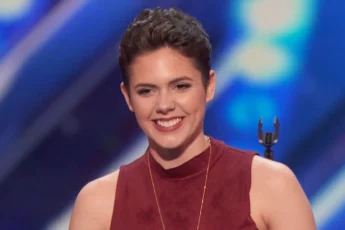

Johnny Shelton, a 25-year-old singer-songwriter from Knoxville, Tennessee, walked onto the America’s Got Talent stage carrying a grief so palpable it seemed to fill the room with him. He began by telling the audience a story that would shape every note he sang: his young son had died of rhabdomyosarcoma on his fifth birthday. The words came quietly, without theatrical flourish, and in that quiet you could feel the weight of years of pain condensed into a single present moment. Johnny described an “empty hole” that followed him after the loss — a loneliness that silenced his music for a long time. For someone whose life had once revolved around songwriting and performing, that silence was its own kind of captivity.
Two months before the audition Johnny had tentatively stepped back toward the microphone. He said it felt like the closest thing to his son he had experienced since the funeral — not a replacement, but a bridge. He had written a song called “That’s Love” for his boy, and when he talked about it his voice wavered in ways that made the audience lean in. He explained that this performance wasn’t about fame or validation; it was a small, deliberate offering meant to fill the void with something positive, to honor the memory of a child he still carried in every part of him. He wanted, simply, to make his son proud.
When the first chords of “That’s Love” floated into the auditorium they felt fragile yet certain, like a candle held steady in a wind. Johnny’s voice wasn’t showy — it was honest, textured with the kind of imperfect beauty that comes from lived experience. The lyrics spoke plainly about the enduring nature of love: how it can’t be bought, how it survives beyond life and time. Phrases about small, everyday moments and the small comforts parents give their children landed like quiet confessions. He sang of lullabies that are hummed even when no one’s listening, of promises whispered in the dark, of a love that does not end with a breath. There were no extravagant runs or forced dramatics; instead, each line sat like a memory being named.
The audience reacted as if they were watching someone unspool a private keepsake. You could see people wiping their eyes, holding their hands to their mouths, heads bowed in a combination of empathy and respect. The hush that fell over the room was not merely silence but attention — the kind that happens when a stranger turns vulnerability into something that belongs to everyone in the room. Judges leaned forward. The camera caught close-ups of faces softened by emotion. At times Johnny’s voice cracked, and the cracks only made his performance more human, more immediate. It was as if every listener recognized, in some form, the truth he was singing about: love’s stubborn refusal to be erased.
When the song ended there was a beat of stunned stillness followed by a warm, lingering applause that felt more like a communal embrace than a usual show-of-support. The judges’ reactions were heartfelt and unanimous. Howard Stern, his voice thick with feeling, said there was “nothing more moving” than what Johnny had just done — not merely the song itself, but the way he sang it, the courage to make such a personal offering on a stage built for spectacle. Mel B, a mother of four, spoke directly to the act of sharing such a raw story; she thanked him for letting the audience into something deeply intimate and called the song “beautiful.” Howie Mandel praised Johnny as a “real artist,” admiring the phrasing and the sound he produced, and he highlighted the bravery implicit in making art amid sorrow.
Each comment was distinct but threaded with the same sentiment: admiration for the way Johnny had transformed private pain into a piece of art that could hold a room. Howard summed it up poignantly, reminding Johnny — and everyone watching — that while we lose loved ones, the love a parent has for a child is indestructible. He offered a consolation that felt both metaphysical and human: that the energy of Johnny’s son was with him in that moment, in the melodic lines and the tremor in his voice.
When the judges voted, the result was unanimous — four “yes”es — and the response felt like an affirmation that went beyond the competition. Johnny left the stage carrying more than just approval; he carried a small reprieve from the silence that had followed his loss, and a reminder that music could be a vessel for both grief and healing. The audition didn’t erase the pain or change the past, but for a few minutes on a national stage, Johnny turned an unbearable absence into a tribute alive with tenderness. He offered a song as proof that although death can take a life, it cannot take the love that remains.