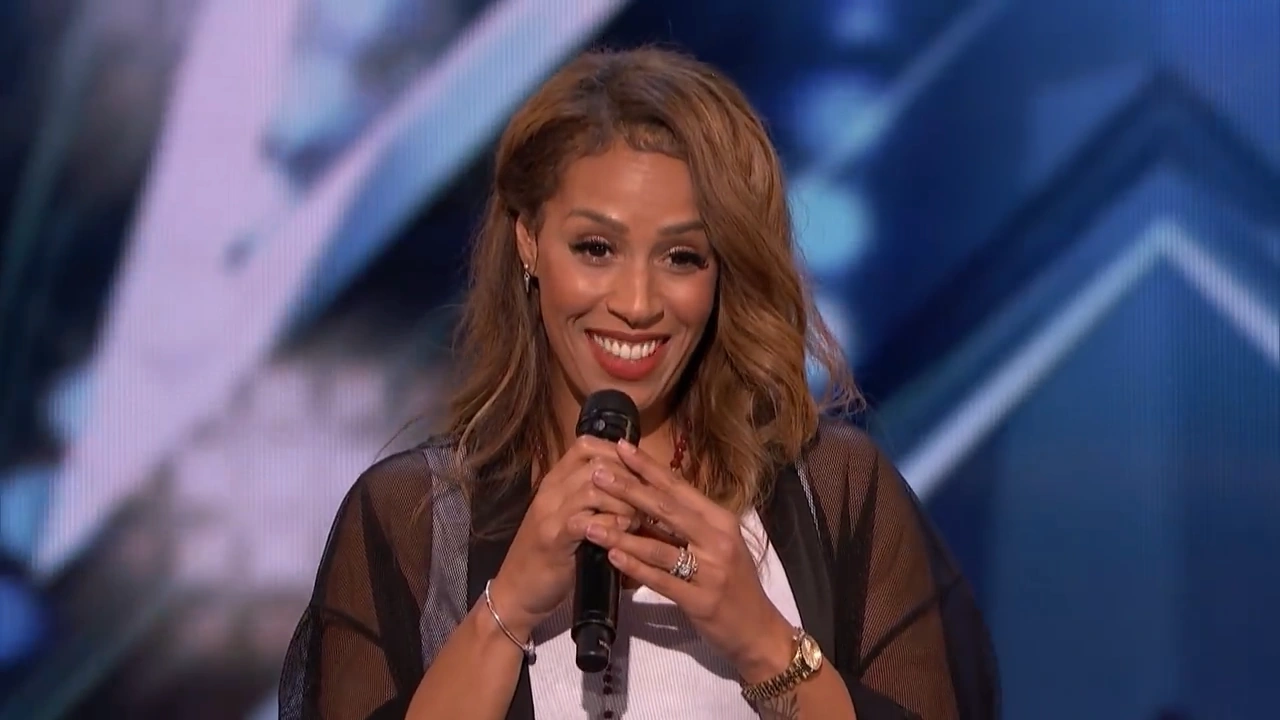
At thirty-nine, Glennis Grace stepped onto the America’s Got Talent stage with a calm determination that hinted at years of rehearsal, hard work, and a long-held dream. She didn’t present herself as a newcomer trying her luck; she spoke plainly about a career already lived but not yet fully realized. For Glennis, singing had never been just a hobby — it was her life. Yet she admitted that a larger stage, a wider audience, and the chance to be seen in America remained goals she hadn’t yet reached. Standing beside her in the wings, her eleven-year-old son Anthony provided a quiet, steady source of encouragement. He had been urging his mother to take this leap, and his belief — earnest, simple, and fierce — seemed to buoy her as she faced the judges and the lights.
The audition felt personal from the start. Glennis explained, with a soft conviction, that she wanted to sing for more people, to show what she’d been honing for years. That sentiment gave the room an intimate quality: this wasn’t just about winning a televised contest, it was about recognition and opportunity. When she announced she would sing “Run to You” by Whitney Houston, there was a noticeable intake of breath across the auditorium. Whitney’s songs are notoriously demanding — full of long phrases, dramatic climaxes, and an emotional range that requires both technical mastery and heartfelt vulnerability.
From the first phrase, the audience and judges understood why she had chosen that particular song. Glennis’s voice entered the space with a clarity and power that immediately evoked the spirit of the original, but also revealed her own musical identity. There was an uncanny similarity in timbre and phrasing to Whitney Houston, yet Glennis never felt like an imitator; she honored the song’s legacy while injecting her own nuance — subtle vocal runs here, a hushed vulnerability in a softer line there. Small moments stood out: the way she leaned into the breath before a high note, the controlled crescendo that made the chorus land with emotional authority, and the gentle, almost conversational inflection she used between phrases to make the lyrics feel lived-in.
Emotion threaded through the performance in a way that made it hard not to watch with rapt attention. Glennis conveyed the yearning and dependence embedded in “Run to You” — the sense of seeking refuge and comfort in a powerful voice. There were technical feats, too: effortless transitions through registers, immaculate intonation during complex melismas, and sustained notes that never wavered. The combination of skill and sincerity is what turned a well-sung song into a moment. By the time the final line faded, the audience was on its feet, and the panel stared, stunned, as though they had just witnessed something rare.
Simon Cowell, whose approving nods are notoriously hard-won, was notably moved. He didn’t offer vague praise; instead he made an unambiguous assessment: watching Glennis, he said, felt like looking at a star already. For someone who built a career critiquing talent with blunt, sometimes brutal honesty, that admission carried real weight. Mel B’s reaction leaned into the comparison many were already making. “You do sound so much actually like Whitney, it’s unbelievable,” she said, the words reflecting both awe and the inevitable resonance that comes with hearing a voice reminiscent of an icon. Howie Mandel captured the practical consequence of that moment: Glennis’s talent needed exposure. “The only reason why you’re not a star yet is because we haven’t seen you and we haven’t heard you,” he observed, framing the audition as less a judgment of ability and more an illustration of missed opportunity.
There was tenderness in the room too. You could see the relief wash over Glennis’s face as the judges’ responses moved from appreciative to emphatic. Her son Anthony, watching from the audience, must have felt the same surge of pride and vindication that any child feels when a parent’s quiet sacrifices are recognized. For Glennis, those four resounding “yeses” were more than votes — they were validation that years of singing, of late-night practice and small-stage gigs, had prepared her for this exact moment.
The standing ovation that followed felt less like a television show cue and more like a community acknowledgment: a collective recognition that a gifted artist had finally been given a stage big enough to match her voice. It was, in every sense, a star-making moment — not because talent shows can manufacture fame overnight, but because they can remove the barriers that keep a powerful voice from reaching its potential audience.
Glennis left the stage having done exactly what she came to do: she proved she belonged on a global stage and reminded viewers that talent, when matched with opportunity and a little push from someone who believes in you — in her case, her young son — can finally find its moment to shine.