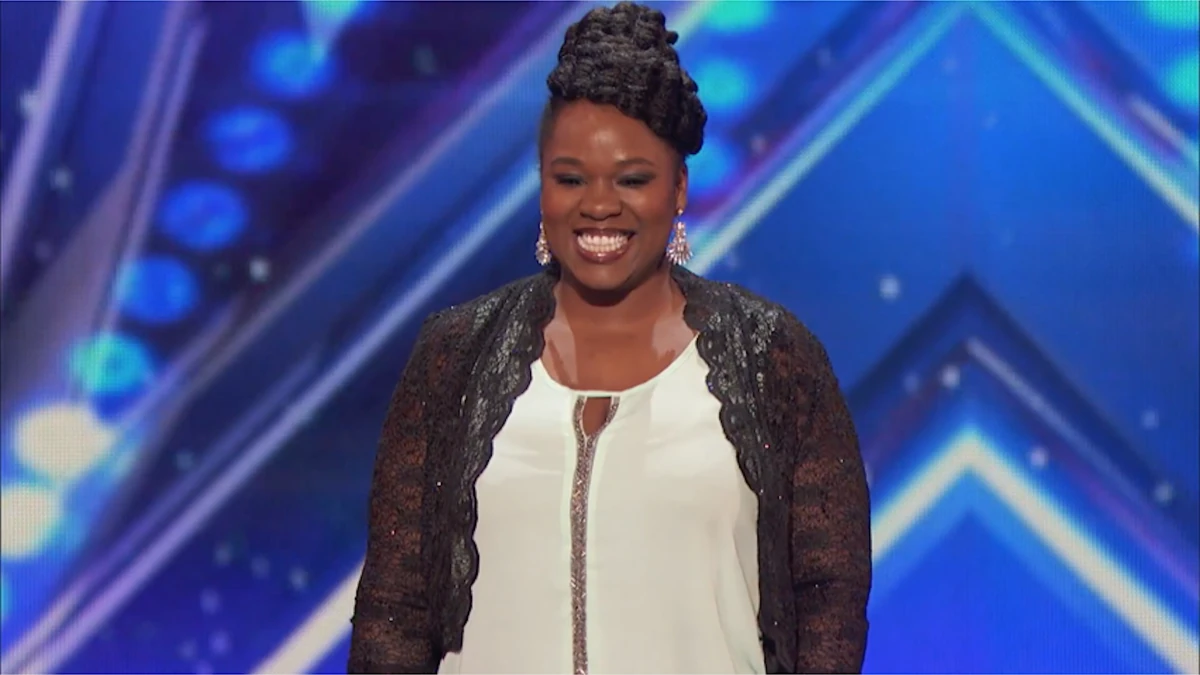
Moya Angela walked onto the America’s Got Talent stage carrying more than a sheet of music — she carried years of quiet sacrifice and a dream she had kept folded in the corners of her life. At 32, the Las Vegas teacher had spent much of her adult life pouring herself into underprivileged students, staying late to tutor, organizing classroom fundraisers and lending an encouraging word to kids who needed one. She spoke about that work with obvious pride, but also with an honesty that revealed something else: amid all that giving, she had often put her own voice last. Singing had been with her since childhood church choirs, a private joy and a refuge, but doubts had lingered. Was her voice truly worthy of a professional stage? Could she step out from behind lesson plans and resource sheets and be seen as an artist?
Those questions were visible in the small signs of nerves — the way she smoothed her skirt, the soft intake of breath before addressing the judges, the quick, grateful smile when her family waved from the audience. Yet there was also a palpable determination. She told the panel she wanted, finally, to stand on her own two feet and prioritize her dream. For someone used to guiding others, that admission felt like a radical act of self-care; it made the room lean in, invested in the moment as if it were a landmark in one woman’s life.
Moya chose a formidable piece to make that statement: Celine Dion’s “It’s All Coming Back to Me Now,” a song notorious for its wide range and dramatic intensity. The selection was bold; it signaled that she wasn’t there to play it safe. When the track began and she took the first timid lines, there was a hush in the arena. Her opening was intimate, almost confessional, as if she were telling her own story rather than performing someone else’s. The soft phrasing invited listeners closer, and you could feel the emotional current building with each measured phrase.
As the song progressed, Moya unfolded layer after layer of vocal craft. She displayed an impressive command of dynamics, starting low and vulnerable before gradually adding power and color. When she hit the mid-section and began to stretch her range, there was no strain — only controlled ascent. Her high notes were rounded and full, not the thin, breathy attempts often heard in auditions. Instead, she married technical control with emotional resonance: a trembling on a quieter syllable here, a steely belt at a climactic phrase there. Those micro-choices made the performance feel lived-in and authentic rather than simply showy.
Small details made the performance stand out. She used her hands sparingly but effectively, letting a gesture underline a lyric. When she paused between lines, those silences were meaningful; they allowed the audience to catch up to what she was saying, to feel the tension of the story. Her facial expressions shifted naturally from vulnerability to fierce resolve as the arrangement swelled, making it clear she wasn’t merely reproducing a famous song — she was telling her own version of it. At the climax, Moya unleashed a soaring run that filled the arena with sound, and the crowd rose instinctively, the thrill of the moment rippling through the room.
The judges’ reactions reflected the room’s energy. Simon Cowell’s declaration — “That’s what we call a singer!” — landed with authority. It wasn’t simply praise; it was recognition that Moya had demonstrated the hallmarks of a true vocalist: control, tone, and the ability to communicate emotion. Howie Mandel’s comment that she was “born to be on that stage” echoed the sentiment that what the audience had witnessed was an artist in her element. Mel B’s observation that Moya had made such a famous song completely her own highlighted something essential about the performance: rather than mimicry, she offered interpretation.
Beyond the one-line critiques, what stood out in the feedback was a consistent appreciation for how Moya balanced technical skill with heart. Judges noted that she hadn’t relied on gimmicks or vocal acrobatics for their own sake; every choice served the emotion of the song. That blend — the marriage of craft and sincerity — is rare, and it explained why the audience response felt so unanimous and warm. Her family’s smiles from the crowd, aunts and siblings beaming with pride, underscored the personal stakes of the night. When the four “Yes” votes came through, the applause felt like shared joy, not just approval.
For Moya, the audition was both culmination and commencement. It marked the end of a long period of self-questioning and the start of a new chapter in which she would, for the first time in a long while, actively pursue her own ambitions. The road ahead would likely bring tough decisions — how to balance a growing performing career with classroom responsibilities, when to audition further or take vocal coaching, how to protect her well-being while stepping into the spotlight. But in that moment onstage she proved two essential things: she had the voice to make people stop and listen, and she had the emotional honesty that makes performances resonate.
She left the stage to a standing ovation, not merely for the technical fireworks but for the story she had chosen to tell with them. Moya Angela’s performance was a vivid reminder that it’s never too late to give yourself permission to dream. After years of putting others first, she had taken a brave, luminous step to claim her own dream — and in doing so, she gave everyone watching permission to reconsider where their own priorities lie.