
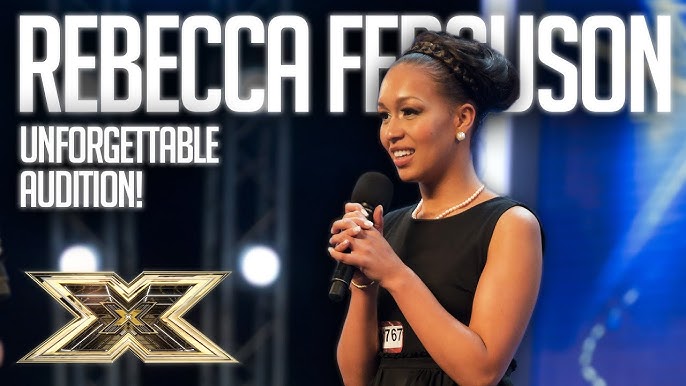
When Rebecca Ferguson walked onto the X Factor stage, she looked every bit the unassuming mother the cameras had described: soft-spoken, wrapped in a simple coat, and carrying an air of genuine humility. There was nothing flashy about her entrance—no dramatic costume, no practiced swagger—just a woman who seemed both grateful and painfully aware of the enormity of the moment. That unvarnished authenticity did something to the room before she even opened her mouth; people leaned in, not out of expectation but out of affection, as if checking in on someone they already liked.
Her backstory helped forge that immediate connection. Rebecca spoke of being a mother of two, of juggling work and auditions, of the quiet hope that pushed her toward the microphone: a desire to offer more to her children, to show them that dreams could be pursued even after life’s responsibilities mount. That combination of vulnerability and grit made her relatable in a way that most flashy contestants are not. It also set up a tension the audience could feel—could this ordinary woman, who admitted to lacking confidence, suddenly summon the kind of voice television shows chase for weeks? The theater seemed to simmer with that question.
When she began to sing A Change Is Gonna Come, the tension evaporated. The first notes rolled out with a warm, smoky resonance that made the room fall almost reverently silent. There was no showboating, nothing designed to elicit cheers; she simply inhabited the song, allowing its line-by-line emotion to emerge. Her voice had a richness that felt older than her years, a timelessness that transported listeners to a place where language and accent didn’t matter so much as the story behind the melody. You could hear the lineage of soul and Motown in her phrasing, but Rebecca filtered those influences through something entirely her own—a lived-in sincerity that made each phrase land like an honest confession.
One of the most striking things about her performance was how she balanced technical command with emotional nuance. There were moments of controlled restraint—where a softer timbre let the lyrics breathe—and moments of full, resonant power that surprised because they felt so natural rather than forced. She threaded delicate runs and held sustained notes with a steadiness that suggested both training and instinct. The judges, who had seen countless hopefuls, visibly shifted in their seats as they recalibrated their expectations. Simon Cowell, often cool and measured, allowed himself a smile that betrayed genuine admiration. Other judges leaned forward, eyes glistening, as if remembering the first time music had moved them in the same way.
Small details amplified the overall effect. At one point, Rebecca closed her eyes and tilted her head, a tiny physical surrender that made the lyrics read like private thoughts shared with an entire arena. Her hands, which had been clasped nervously at the start, softened into gestures that punctuated the music without drawing attention away from it. In the front rows, audience members wiped their eyes; behind the judges, production staff paused mid-task to witness what was unfolding. Those discrete reactions—people reacting privately and visibly—made the audition feel less staged and more like a communal experience of discovery.
When the final note faded and a moment of stunned silence hung in the air, the release was instantaneous. The applause rose, not as polite recognition but as a collective standing ovation from a crowd who had just been taken somewhere together. The judges rose as well, some of them on their feet before the sound had fully subsided. Their praise was effusive but precise; they didn’t simply call it good—they tried to explain why it felt important. Comments about her voice being “world-class” and “instantly recognizable” echoed through the post-performance interviews, but what mattered most was the sense that they had been witness to a true transformation: a woman who had entered the stage tentative and left towering in presence.
That viral moment spread quickly. Clips of her audition circulated online, accompanied by commentary that ranged from astonished admiration to heartfelt congratulations. For many viewers, Rebecca’s performance was more than a remarkable audition; it was an emotional lesson about possibility and courage. People wrote about being inspired to pursue a deferred dream, to take that leap they’d long postponed. Others commented on the humanity of the moment—how it reminded them that talent often hides behind ordinary lives and that the most powerful performances are those born of authenticity rather than artifice.
In the weeks and months that followed, Rebecca’s audition continued to resonate because it distilled a hopeful idea: that self-doubt need not be the final word on potential. Watching her go from a nervous mother to a confident, commanding vocalist offered viewers a narrative they could root for—one where perseverance and heart yield undeniable results. Her journey on that stage remains a touchstone for anyone who has felt small in the face of a big dream, a vivid testament to how a single, honest performance can change not only a career but the way millions of people see what might be possible for themselves.