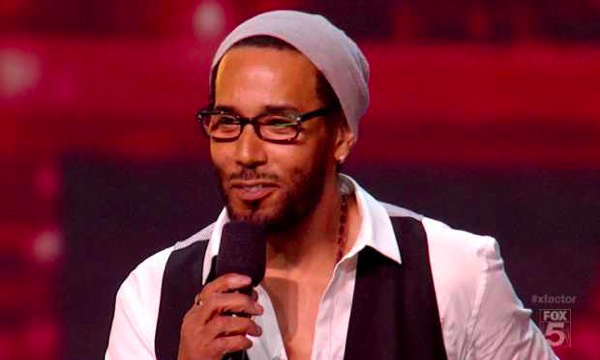
When Leroy Bell walked onto the bootcamp stage of the American X-Factor, you could feel something different in the air. He carried himself with a quiet assurance that only comes from decades of living close to your craft — not the nervous jitter that often accompanies first-time contestants, nor the calculated swagger of someone chasing trends. At well over fifty, Bell’s presence was immediately arresting: a calm, steady gaze, a posture that spoke of long nights in small clubs and late drives between gigs. When he opened his mouth, the sound that filled the room confirmed what the face and posture had promised. His voice was smooth and warm, shaped by experience, and it moved with a measured power that didn’t need to shout to be heard.
There’s something especially compelling about watching someone who has lived a full life step back into the light. Leroy’s performance felt like a distillation of all those years—every missed opportunity, every unpaid rehearsal, every stubborn late-night practice—compressed into a single, unforgettable minute. He didn’t try to out-sing the younger contestants with flashy acrobatics; instead, he offered the audience something rarer: nuance. His phrasing was deliberate, each syllable weighted with intention. Where other singers might rely on runs and tricks to impress a panel, Bell used silence and restraint as tools, sculpting the song so the emotion rose naturally rather than being forced. That restraint made the climactic moments feel earned, and when he let the notes bloom, they carried the authority of someone who has learned how to protect a voice and use it wisely.
The competition’s stakes amplified every nuance of his performance. Bootcamp is where potential is sifted and expectations meet reality; being surrounded by much younger singers—some with glossy production photos and viral follower counts—could have made Leroy seem out of place. Instead, the age difference became the heart of the story. Watching him stand toe-to-toe with fresh-faced hopefuls created a compelling contrast: youthful ambition on one side, weathered skill on the other. That contrast is a storytelling goldmine for viewers. People love narratives of second chances and late bloomers, and Bell’s audition fit that archetype perfectly. It’s not simply that he sang well; it’s that his performance suggested a life’s worth of practice finally finding a door wide enough to open.
Concrete details made the moment feel authentic. Bell’s wardrobe was understated—a well-worn jacket, a shirt picked for comfort rather than image. When the camera lingered close, you could see the lines at the corners of his eyes and the faint calluses on his fingers, small markers of time and work. During quieter passages he closed his eyes, as if listening to himself from a place outside the stage, then opened them to connect with the judges on the louder phrases. Those tiny behaviors told a story: this was someone who had learned to balance technical skill with emotional honesty, and to let the song speak through the life he’d lived.
Simon Cowell’s reaction helped crystallize the moment for viewers. Known for his blunt assessments, Simon’s recognition of Bell’s age and artistry served as a powerful validation. When a critic with a reputation for cutting remarks acknowledges not just talent but the beauty of a late-blooming career, it shifts the conversation. That kind of endorsement reverberates on social platforms where clips are shared, reshared, and repackaged with captions about perseverance and reinvention. In the days after the show, short edits of Simon’s nod and Bell’s final note began circulating across social media, picked up by fans of underdog stories and by older viewers who saw themselves reflected in his journey.
Why do these stories go viral? Part of it is the intrinsic drama of the competition—the tension of whether a single performance can change a trajectory. But there’s a deeper reason: audiences crave hope. In an industry that often prioritizes youth, Leroy Bell’s audition provided a counter-narrative: skill can mature, and opportunity can arrive late but with full force. People shared the clip not only because the singing was excellent, but because the performance carried an emotional payload that felt universally relevant. Comments praised the “realness” in his voice, the way he made a simple lyric land like a life lesson, and the dignity with which he carried himself on a stage that can easily commodify vulnerability.
Beyond the immediate applause and social-media metrics, moments like Bell’s performance matter because they broaden what we imagine is possible. For aspiring artists who shelved their dreams, for hobbyists who wonder whether age disqualifies them, and for audiences tired of formulaic youth-focused narratives, his audition was a reminder: passion doesn’t expire. Talent can simmer for years and still flare into something bright and unmistakable. Leroy Bell’s bootcamp moment wasn’t just another audition—it was a testament to resilience, to the quiet accumulation of craft, and to the idea that life can give you the chance to start over at any age. That message, wrapped in a voice that felt both lived-in and luminous, is why his performance resonated far beyond the walls of a TV studio.