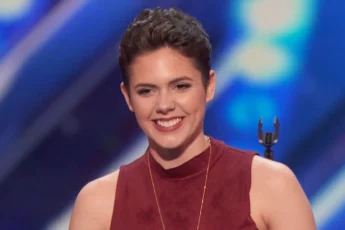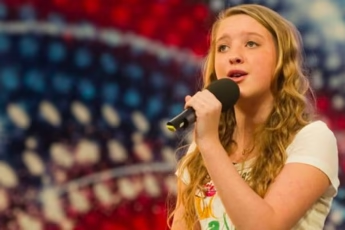
When Sydnie Christmas walked onto the Britain’s Got Talent stage in 2024, she didn’t look like someone trying to steal the show by force. There was no theatrical entrance, no costume drama — just a young woman who seemed quietly determined, hands folded, shoulders relaxed but with that barely perceptible tremor that comes from nerves. She introduced herself softly, said she was going to sing “Tomorrow” from Annie, and for a moment the air filled with the familiar collective sigh that happens whenever a contestant chooses a well-known musical number. “Tomorrow” can be a trap on a talent show: sentimental, overused, and easy to flatten into something forgettable if the performer leans on nostalgia rather than artistry.
Sydnie did none of that. From the very first note, it was obvious this was going to be different. Her voice stepped forward with a kind of theatrical warmth — not the thin, vanilla sweetness some renditions fall into, but a fully shaped tone that suggested both technical training and emotional truth. She didn’t belt just to prove she could hit the notes; she shaped phrases, lingered on vowels when it benefited the line, and let certain words breathe so they landed like little revelations. That combination of control and feeling is rare on an audition stage where nerves can make singers rush or overwork phrases.
The arrangement she chose felt thoughtful. Rather than mimic a Broadway orchestra or lean on a grand piano swell, the accompaniment gave her space, building delicately as the song progressed. That decision let the song’s arc breathe: the quiet hope in the opening lines, the gentle planning of dreams, and then the swell into determination and joy. As the music rose, Sydnie’s voice rose with it, but always with intention. When she reached the higher passages, there was power without strain — a register that rang clear and carried the emotional weight of the lyrics.
You could almost feel the audience shifting in their seats as she sang. What started as polite attention turned into focused listening. Some faces visibly softened; a few mouths tightened with the kind of feeling that arrives when a familiar lyric is suddenly given a new life. The judges’ expressions were revealing. Amanda Holden, who’s known to wear her emotions on her sleeve, watched with that look of surprise that starts with the eyebrows and spreads into a warm smile. Other judges leaned forward, eyes tracking every nuance, as if they were following the arc of a story being told in real time.
It wasn’t just technical prowess that lifted the performance — it was Sydnie’s interpretive choices. There were small moments where she flirted with theatricality in a way that felt earned, not showy: a subtle rhythmic delay on a line that made the next phrase land harder, a softened consonant that allowed the vowel to bloom, and a controlled breath that created an intimate space between singer and listener. Those micro-decisions made the journey from verse to chorus feel personal. In a song that can too easily become generic, Sydnie made it bespoke.
The reaction built naturally. Applause rippled at the end of key phrases; by the bridge, the audience was leaning in, and when the final chorus came she gave everything she had — not screaming for effect, but delivering a full-throated, emotionally honest climax. Then there was a moment of silence, the kind you get when a room is collectively stunned, followed by cheering that rose quickly into a standing ovation. People didn’t just clap; they rose and whooped, as if they’d been part of something unexpectedly moving.
Amanda Holden’s response was immediate and unmistakable. She stood, walked confidently to the golden buzzer and pressed it, the sound punctuating the moment like a punctuation mark — final and celebratory. Gold confetti exploded down the stage and into the audience, and for a beat Sydnie stood under that shimmer, taking it in with a stunned, grateful smile. Amanda’s decision sent Sydnie straight through to the next round without the usual deliberation, but it was clear the choice wasn’t about television spectacle; it was a gut reaction to a performance that had connected on a human level.
What made this audition stick with people wasn’t only the Golden Buzzer theatrics. It was the reminder that a familiar song can still surprise you if someone brings a fresh, honest perspective to it. Sydnie didn’t rely on gimmicks or heavy-handed drama; she trusted the melody and the truth in the lyrics. She treated “Tomorrow” not as a headline but as a conversation — about hope, about resilience, about the small, stubborn belief that better days come. That sincerity translated to viewers at home as well as people in the theatre.
By the time she left the stage, Sydnie had become one of the season’s most talked-about moments. Clips of her performance spread online, with viewers praising the vocal control and emotional clarity she’d shown. For many, the image that stayed was simple: a young singer, calm in presence and ferocious in feeling, who took a song everyone thought they knew and made it feel new again. Amanda’s Golden Buzzer was the dramatic punctuation — but what people remembered was the performance underneath it: honest, theatrical, and surprisingly powerful.