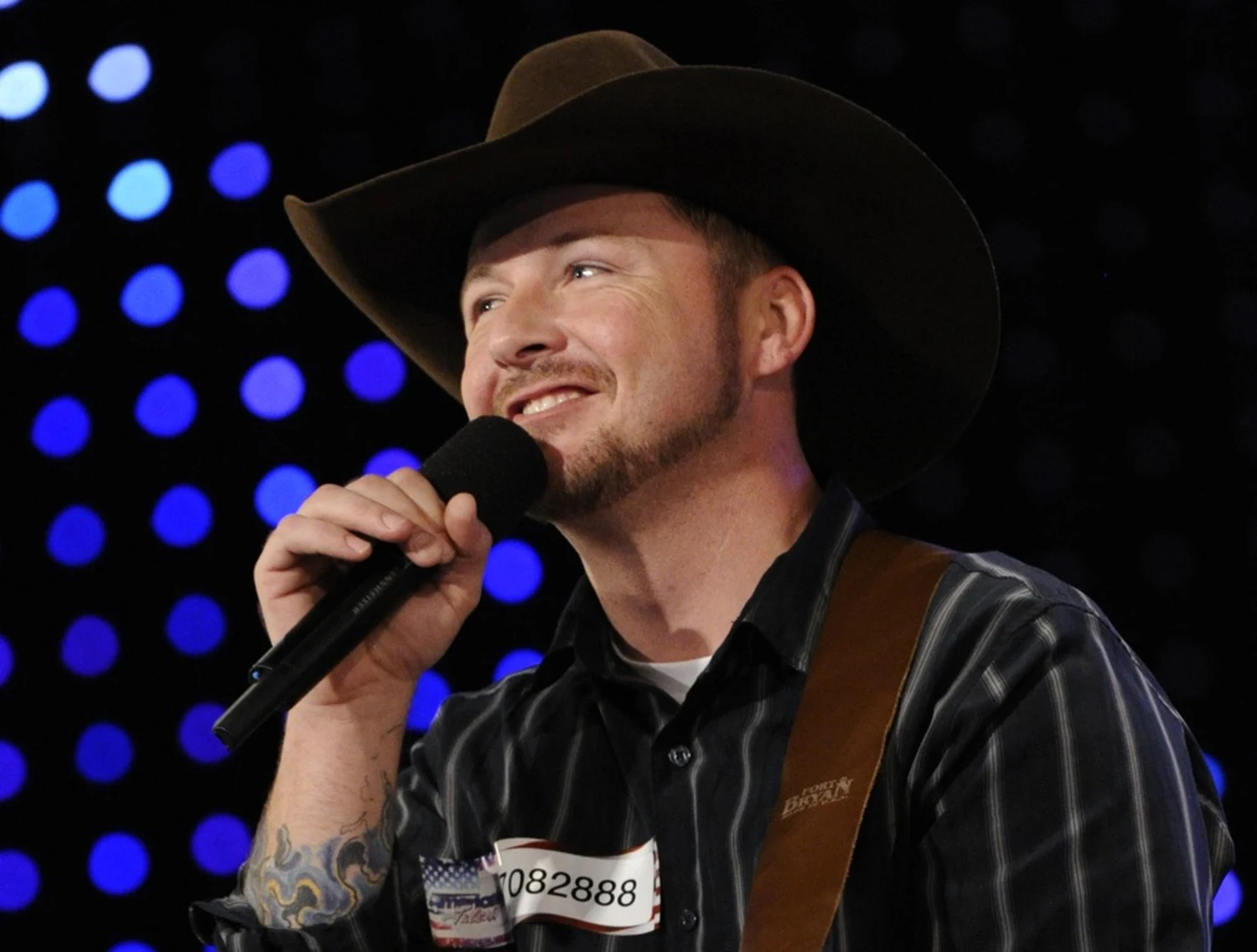
Tim Poe’s audition on America’s Got Talent is one of those performances that stays with you long after the screen goes dark. He walked onto the stage with the quiet, steady presence of someone who has faced far more than most of us can imagine. Tim introduced himself not as a performer first but as a man who had served his country for fourteen years. His voice, when he spoke, carried the weight of those years — measured, deliberate, and marked by a stutter that reminded the audience of the price he paid in service. He didn’t shy away from the truth: in 2009 he was struck by a grenade in Afghanistan while trying to shield his team. The blast broke his back and caused a severe brain injury, leaving him with a persistent speech impediment that has altered the way he communicates every day.
As he recounted the events, you could see how those experiences had settled into him. There was a humility in the way he described his recovery, a recognition that the wounds were both physical and invisible. He talked about the long road of rehabilitation — the surgeries, the therapy, the small wins and the daily frustrations. Maybe most striking was his honesty about how the injury affected not just his body but his sense of self. Speaking was a struggle; expressing feelings felt like scaling a wall. Yet through that struggle, music had become an unexpected doorway. He explained that during speech therapy his pathologist suggested trying singing as a technique to help manage the stutter. It was a practical recommendation, but for Tim it turned into something far more profound.
When he began the first lines of “If Tomorrow Never Comes,” the shift in the room was immediate. The stutter that punctuated his spoken words seemed to fall away, replaced by a smooth, earnest singing voice that carried a deep, soulful quality. It wasn’t a flashy, showy performance—there were no acrobatics or unnecessary vocal runs—just a straightforward, heartfelt delivery that let the lyrics do the work. Each phrase was wrapped in feeling; every breath sounded like a piece of his life laid bare. The contrast between the hesitant way he told his story and the fluidity of his singing made the moment feel almost miraculous, but anyone watching closely could also see the hard work behind it — the countless hours of therapy, the rehearsals, and the courage it takes to step into a spotlight knowing your vulnerabilities will be on display.
The emotional gravity was amplified by the simple staging: Tim standing there with a microphone, not hiding behind theatrics, allowing the song to act as his voice in a new way. The audience and judges leaned in. You could witness the human reaction unfold — hands to mouths, tears welling, a hush that spoke louder than applause. Howard Stern and the other judges were visibly moved, not just by the quality of the singing but by what it represented: resilience, adaptation, and the rediscovery of a means to connect. The unanimous “yes” that followed felt less like a vote and more like an embrace, an acknowledgment that this was a man who had transformed pain into expression and, in doing so, had offered everyone watching a moment of genuine human connection.
Beyond the immediate television moment, Tim’s story resonates because it speaks to the transformative power of creative therapy. His pathologist’s suggestion to sing as a therapeutic tool highlights how art can intersect with medicine in deeply meaningful ways. For someone whose daily life is constrained by a disability, finding a method to communicate freely is life-changing. Singing didn’t erase his injuries or the challenges he continues to face, but it gave him back something invaluable: a way to be heard without the barrier that had defined so much of his post-injury life. In the simplest terms, music became both medicine and language.
After the audition, conversations about Tim’s performance rippled across social media and beyond. Viewers praised not just the voice but the bravery it took to stand in that spotlight. Veterans, people with speech disorders, and countless others found something to relate to in his story — a reminder that progress often arrives in unexpected forms. For Tim, the stage offered more than advancement in a competition; it offered a platform to show that recovery and reinvention are messy, beautiful processes. The audition remains a powerful reminder that courage takes many shapes, and sometimes the most profound ones are revealed when a person chooses to sing their truth.