
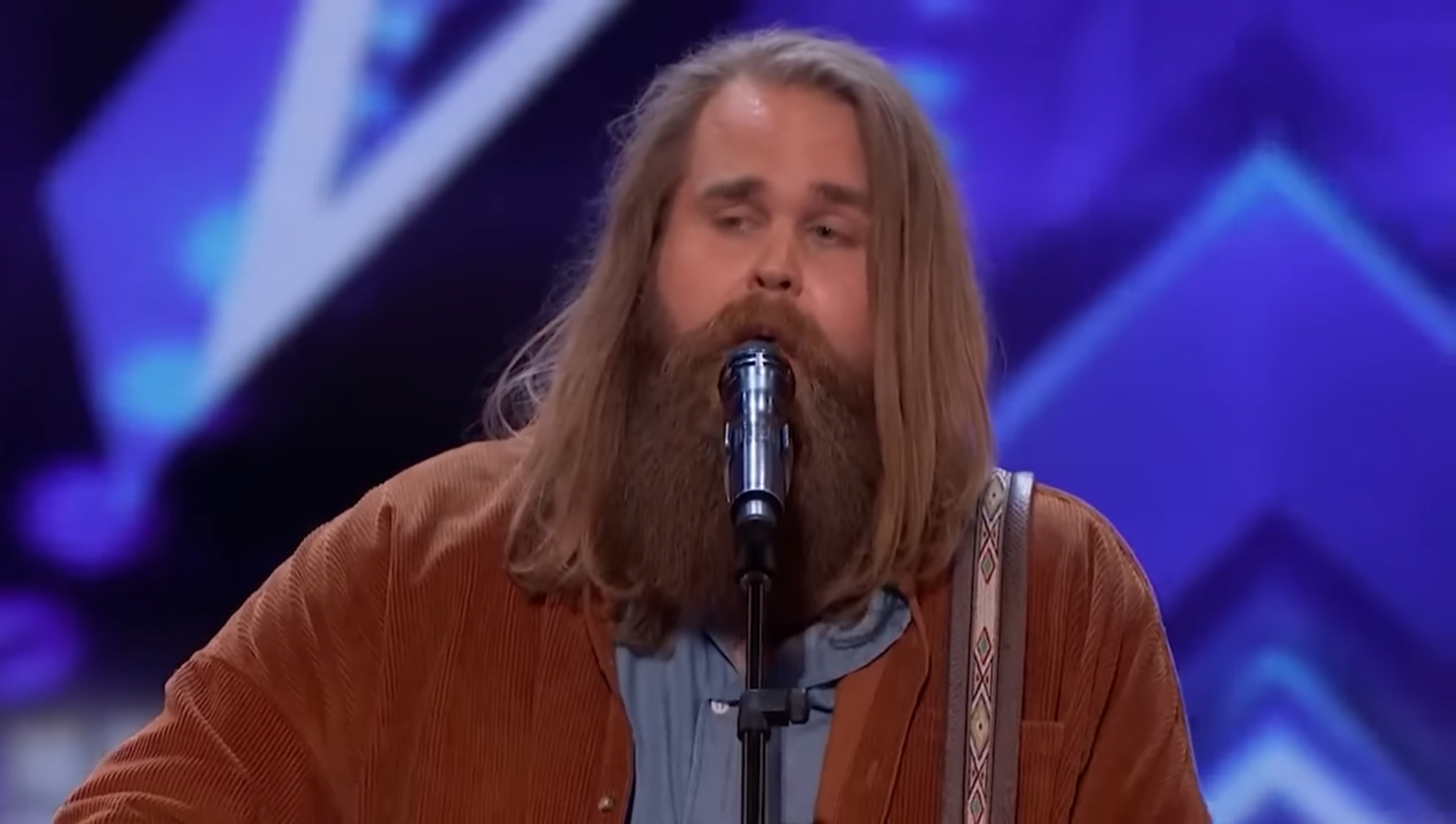
Chris Kläfford’s walk onto the America’s Got Talent stage felt unassuming at first: a quietly dressed man from a small village in Sweden, carrying the kind of humility that makes you listen a little closer. When he spoke to the judges, his voice was soft but earnest, and he mentioned rock bands like Kiss as part of the musical backdrop that shaped him. That detail — a nod to louder, theatrical influences — was an unexpected hint that something powerful might be waiting beneath his calm exterior. There was an almost cinematic contrast between his modest introduction and the enormity of the stage he had traveled across oceans to reach, a reminder that great talent often arrives wrapped in simplicity.
Chris explained that he’d come a long way, not just geographically but in the sense of pursuing a dream. Growing up in a small village, opportunities to be seen on a global platform are rare; yet here he was, representing all the quiet determination of artists who grind in obscurity until one moment changes everything. That context made the audience lean in even before the first note. It set up a narrative many could root for: the local singer with big ambitions, willing to cross borders and conventions to let his voice be heard.
Then he began to sing. Choosing John Lennon’s “Imagine” was itself a bold move — the song is an icon, a piece of musical history that carries enormous weight and personal associations for listeners. But Chris didn’t try to mimic the original; he brought his own sensibility to it, reshaping the melody with subtle phrasing and a timbre that felt both weathered and pure. From the first lines, his voice had a weathered, resonant quality that suggested life experience and a deep understanding of the song’s plea for peace. He didn’t lean on vocal pyrotechnics; instead, he let each word breathe, giving the lyrics room to land and settle in the hearts of those listening.
There were small choices in his delivery that revealed a thoughtful artist at work. At moments he softened into an intimate whisper, drawing the audience close, and at others he swelled with a clear, ringing tone that filled the theater. Those dynamics made the performance feel like a conversation rather than a showpiece, as if he were inviting everyone to imagine alongside him. You could see people in the audience closing their eyes, mouths falling slack at the simple beauty of the interpretation. Tears began to appear — not from theatrical manipulation but from the genuine emotional pull of a man who took a beloved song and made it unmistakably his own.
The power of the moment came not only from the voice but from the way Chris inhabited the song. There was a vulnerability in his posture, a humility that made the performance feel honest. He didn’t perform to impress; he performed to communicate. That approach resonated strongly with the judges, who judge not only on vocal ability but on authenticity and artistic vision. Simon Cowell, known for his exacting standards, later called the performance “touching,” a succinct phrase that carried the weight of a hard-earned compliment. Howie Mandel praised Chris for his reinterpretation, recognizing the courage it takes to take on an anthem and twist it into something personal without disrespecting its origins.
When the final chord faded, the studio was silent for a heartbeat — the kind of hush that follows a performance when people are trying to process the intensity of what they’ve heard. Then the applause began, building quickly into a standing ovation that seemed to come from every corner of the room. Chris himself was visibly moved; his eyes glistened and his voice trembled slightly as he absorbed the reaction. That reaction was more than a response to a strong voice; it was a recognition that he had bridged cultural and emotional distances. For an audience in America to be so deeply touched by someone from a Swedish village underscored music’s unique ability to transcend language and borders.
The unanimous “yes” from all four judges was both a formality and a celebration. It meant Chris would continue in the competition, but it also felt like collective approval of an artist who had taken a risk and succeeded. For Chris, the moment was a culmination of years of work and perhaps the start of something larger — a career that could now reach beyond the familiar confines of his hometown. For viewers, his audition was a reminder that true artistry often arrives quietly, builds slowly, and then, without fanfare, breaks open a room.
Beyond the immediate drama of applause and praise, the performance left a quieter impression: the reminder that songs we think we know can be rediscovered through a single sincere interpretation. Chris Kläfford’s rendition of “Imagine” was not an attempt to compete with the past but to converse with it, to find a contemporary, human center inside an old hymn of hope. In that moment, on a stage lit for spectacle but surrendered to honesty, he proved that artists who bring truth to their music can move people in the most profound ways — and sometimes, that’s enough to bring an entire audience to tears.