
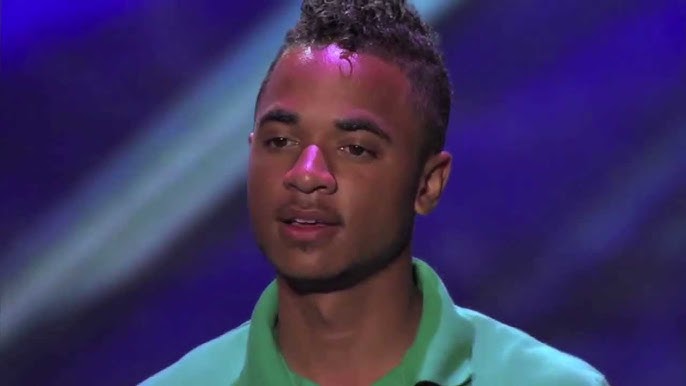
The stage of The X Factor has seen its fair share of unusual auditions, but every so often a performance arrives that leaves everyone unsure of what they’re watching—at least at first. That was precisely the case when Wesley Mountain stepped into the spotlight. From the moment he appeared, there was an intensity about him that immediately set the tone. He wasn’t shy, and he certainly wasn’t reserved. In fact, his focus seemed locked almost entirely on one person: Kelly Rowland.
As he introduced himself, Wesley’s energy felt less like a standard audition and more like a bold, slightly awkward attempt at establishing a personal connection. His comments leaned into flirtation; his gaze aimed squarely at Kelly with a steadiness that made a few people in the audience shift uncomfortably. The laugh that bubbled here and there from the crowd sounded nervous rather than amused. Some patrons exchanged puzzled glances; others raised eyebrows. Even the judges, usually quick to recover their poker faces, looked momentarily taken aback—trying to decide whether this was deliberate showmanship or just plain awkwardness.
That uncertainty grew when Demi Lovato bluntly labeled his behavior “creepy.” Her remark landed like a bucket of cold water and could have ended the audition right then. There was a charged silence for a heartbeat, as if the room collectively held its breath. Would Wesley fold under the scrutiny? Would he make a hasty exit amid embarrassed chuckles? The choreography of live TV often hinges on moments like these—moments that can either derail a contestant or set the stage for an unforgettable turnaround.
Wesley, however, didn’t appear fazed. He squared his shoulders, took a steadying breath, and when the music began, he let his voice lead the way. Choosing Hunter Hayes’ “Wanted” was an interesting move: it’s a song that depends on vulnerability as much as vocal control. As soon as he started, the awkwardness that had dominated the opening dissolved. His tone was smooth, controlled, and surprisingly refined. Where his earlier words had seemed performative, his singing felt sincere. The same man who had created tension with a lingering stare now delivered lines with a softness that revealed something entirely different—an emotional core that hadn’t been visible during the banter.
Watching the room shift was fascinating. People who’d been laughing nervously now leaned forward; a few audience members closed their eyes, letting the melody wash over them. There was a tangible recalibration in the judges’ seats. The earlier skepticism softened into curiosity, then into genuine appreciation. Wesley’s phrasing showed restraint; he didn’t rush through the lyrics or try to overpower the arrangement. Instead, he let key phrases breathe, finding subtle dynamic swells that gave the performance shape and feeling. Small touches—a tender slide into a note, a faint tremble on a particularly earnest line—made the performance feel personal rather than polished to the point of sterility.
Even so, Wesley’s unique personality didn’t vanish. Simon Cowell, never one to miss an opportunity for a quip, likened Wesley’s earlier intensity to “a hungry dog eyeing a steak.” The comment drew laughter and helped defuse the lingering discomfort. It was a reminder that part of this show’s appeal is watching contestants navigate the messier human moments under bright lights. But behind the humor there was also respect: Simon’s attention signaled that, for all the oddities, Wesley had something worth noting.
When the final note faded, the applause was heartfelt. It wasn’t the tentative clapping that sometimes follows a shaky audition; it was warm and sustained, the kind that suggests people had been genuinely moved. The judges took a beat before offering feedback, weighing both the performance and the behavior that preceded it. They acknowledged his vocal ability and the emotional connection he’d brought to the song, while also being candid about presentation. Several suggested he tone down the overly intense gestures and flirtatious comments—advice aimed not at criticism so much as at helping him let his talent shine without distraction.
In the end, all four judges granted him a “yes,” sending him through to the next round. The decision felt like more than a vote; it was a recognition of potential. Wesley had rewritten the narrative of his audition in real time, turning a moment that could have been defined by discomfort into one remembered for a surprising display of heart and skill.
As he left the stage, there was a sense that everyone had just witnessed something unusual but undeniably human. Wesley’s audition wasn’t neat; it didn’t fit the tidy arc viewers often expect. Instead, it unfolded messily and authentically—awkward opening lines, a judge’s blunt callout, then a voice that quietly forced people to listen. In a competition built on first impressions and quick judgments, his performance was a reminder that talent can appear in unexpected packages—and that sometimes, the most compelling moments are the ones that surprise us the most.