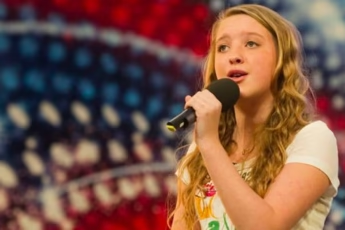
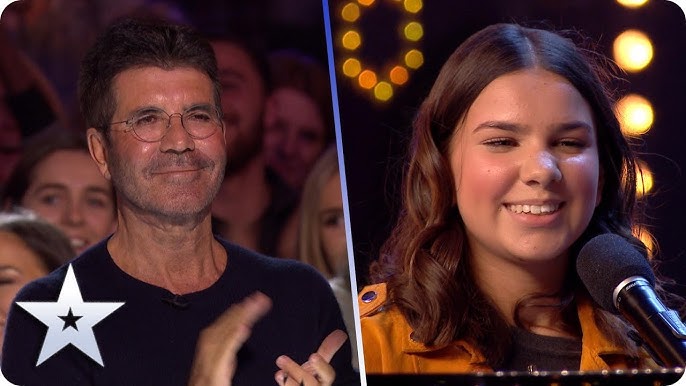
When 14-year-old Sirine Jahangir walked onto the Britain’s Got Talent stage, something extraordinary happened in the space between her first step and the first note. The chatter that normally fills a studio hushed almost immediately, as if the room itself was leaning in to listen. There was a stillness that felt reverent rather than awkward — the kind of hush that suggests people expect something important to happen. Sirine’s opening words made that expectation concrete. Calmly, with a quiet bravery, she told the judges she had lost her sight and then offered the line that would shape the whole moment: “Music is my vision.” That simple sentence did more than explain her connection to sound; it reframed the audition as more than a display of talent. It became a small, intimate act of storytelling about how a person sees and feels the world.
She sat at the piano and prepared to sing “Salvation” by Gabrielle Aplin, and from the opening chord you could tell she’d thought deeply about how to inhabit the song. She didn’t try to overwhelm the room with theatrics or dramatic runs. Instead, she began with a softness that felt deliberate — a voice that was pure and unforced, the kind of sound that invites listeners to step closer rather than impress them from a distance. Her touch on the piano matched that restraint; her hands found the right balance between accompaniment and conversation, the chords supporting her without crowding the vocal line. This combination made the performance feel personal, like sitting with someone who’s leaning in to confess something true.
There were small, human details that made the moment feel real rather than produced. Sirine’s breathing was steady but visible, a tiny inhale before a phrase that revealed both concentration and courage. Her family, seated somewhere in the wings, reacted in ways that were tender and immediate — a hand over a mouth, an intake of breath, eyes glistening. Those reactions made you aware of the stakes: this was not just a television moment but a family’s hope playing out in public. On the judges’ panel, expressions shifted subtly. Faces that often read with practiced neutrality softened into something more vulnerable. People expect judges to be evaluators, but in that instant they became witnesses, absorbing what Sirine was offering with an openness that made viewers at home feel the change in atmosphere.
As the song unfolded, Sirine’s control was noteworthy. She navigated the melody with an evenness that made emotional rises feel earned rather than performative. When she chose to linger on a word, it felt like a deliberate decision to give that line extra weight. When she moved into the chorus, her tone widened with a warmth that filled the auditorium. The arrangement—simple piano and voice—left no room for anything but honesty. There were no backing tracks, no layered harmonies to hide behind. That scarcity makes vulnerability beautiful, and vulnerability, in turn, makes for some of the most memorable television.
The audience’s response tracked the arc of the performance like a living waveform. Early curiosity turned to attentive silence, then to a swelling of feeling that was almost palpable. People who had been chatting fell into quiet until you could hear the soft scrape of someone shifting in their seat. By the time Sirine reached the final lines, the collective intake of breath felt like a shared exhale of recognition. The applause that followed didn’t start as a polite clapping; it was immediate and genuine, surging from the floor seats and sweeping up into the balconies until the London Palladium was standing. It was the sort of ovation that only comes when an audience understands they’ve seen something rare.
The judges’ reactions became part of the narrative afterward. Amanda Holden’s reported tears weren’t an overreaction but a mirror of what many viewers felt: a mix of pride, tenderness, and awe. David Walliams’ remark — that although she couldn’t see it, the whole theatre was standing and applauding for her — landed with sincerity. Those moments of commentary did more than validate Sirine’s talent; they underscored the emotional truth of the performance. In a show often driven by flashy auditions and viral moments, this one was memorable precisely because it favored quiet power over spectacle.
Looking back, it’s clear why this audition became one of the most talked-about moments of the 2020 series. Sirine didn’t perform to shock or to dominate; she invited people to witness how music can be a way of seeing. The combination of a candid introduction, thoughtful musicianship, and an honest vocal delivery created a scene that resonated beyond the studio. For a few minutes, viewers were given a glimpse of how art can transcend limitations and bind strangers together in empathy. That’s the kind of performance people remember not just for the notes, but for the way it made them feel.